
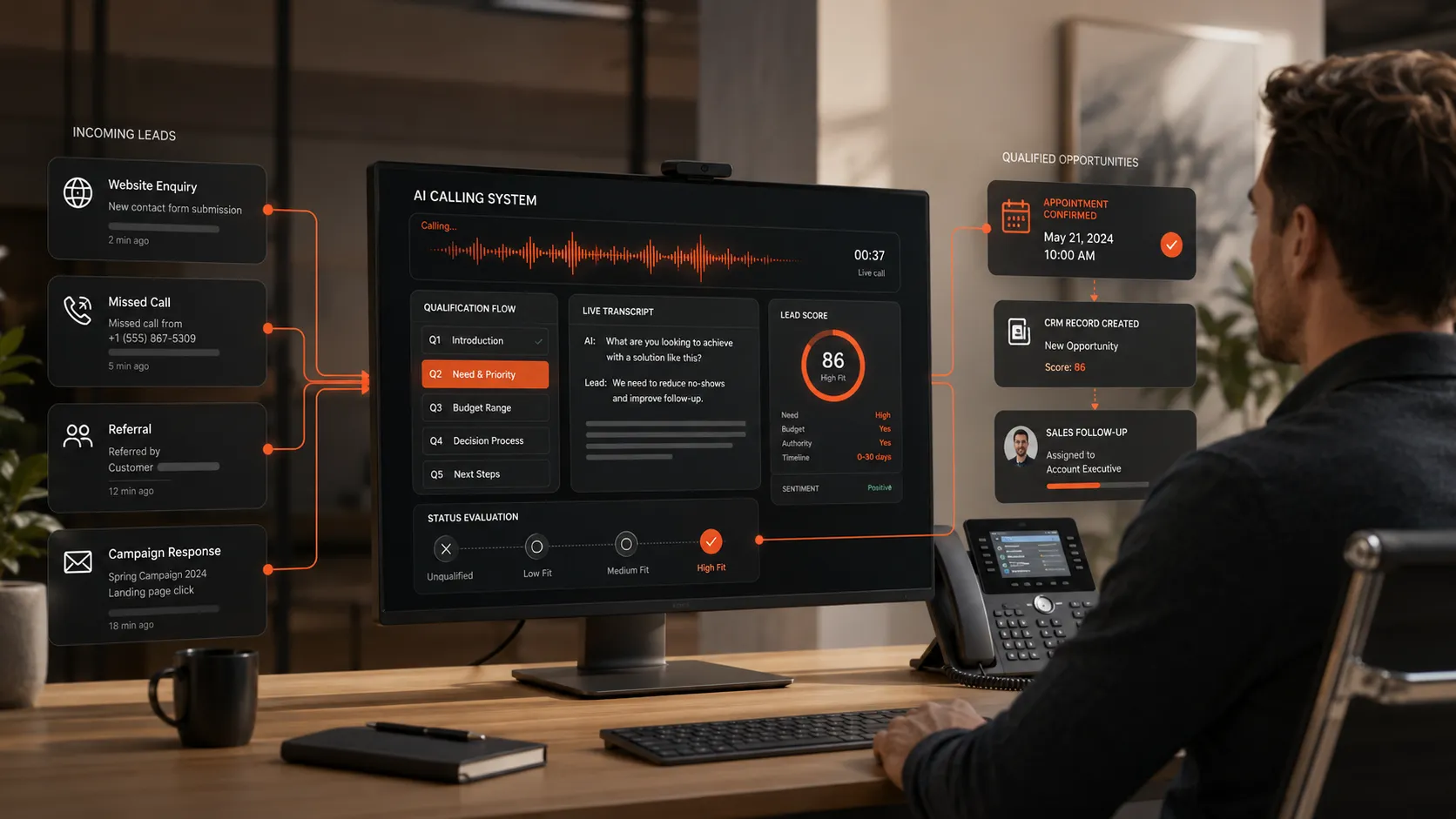

Generating leads is only the first part of the sales process. The real challenge is responding quickly, identifying which prospects are genuinely interested, collecting the right information, and moving qualified opportunities toward the next step.
Many businesses invest in websites, paid advertising, social media, search engine optimisation, referrals, and lead-generation platforms. These channels may produce enquiries, but those enquiries do not automatically become customers.
A lead may submit a form and wait several hours for a response. Another may call while the sales team is busy. Some prospects may have strong buying intent, while others may only be researching. When every enquiry is handled manually, sales teams can spend too much time chasing low-quality prospects and not enough time speaking with people who are ready to move forward.
AI calling services help businesses improve this process by automating lead response, qualification, follow-up, appointment scheduling, and call outcome tracking.
An AI voice agent can answer inbound enquiries or make approved outbound calls using a workflow created around the business’s sales process. It can ask qualification questions, collect customer details, score lead quality, book appointments, and transfer high-priority prospects to a human representative.
This gives businesses a faster and more structured way to generate value from the leads they already receive.
What Are AI Calling Services?
AI calling services use conversational voice technology to manage business phone calls.
These services may include inbound AI voice agents that answer calls from prospects and outbound AI voice agents that contact leads for follow-up, qualification, reminders, or appointment setting.
The voice agent is configured using:
- Business information
- Approved scripts
- Qualification questions
- Service details
- Routing rules
- Appointment availability
- Lead-scoring criteria
- CRM or calendar integrations
- Human escalation instructions
The system can listen to a prospect, understand the response, ask relevant follow-up questions, and complete an action based on the conversation.
For lead generation and sales teams, the objective is not simply to make more calls. The objective is to identify better opportunities and move them through the sales process more efficiently.
How AI Calling Supports Lead Generation
AI calling does not replace marketing channels such as search, advertising, referrals, or content marketing. Instead, it helps businesses respond to and convert the interest those channels create.
A business may generate leads through:
- Website contact forms
- Quote requests
- Landing pages
- Paid advertising campaigns
- Social media promotions
- Online directories
- Referral programmes
- Event registrations
- Previous customer databases
- Missed inbound calls
AI calling services can connect these lead sources with an automated response workflow.
When a lead submits an enquiry, the system may trigger a call, ask whether the person is available to continue, gather additional details, and book a sales conversation.
This reduces the gap between the moment a person shows interest and the moment the business responds.
1. Faster Response to New Enquiries
Lead response time can have a major effect on whether a prospect continues the conversation.
A person requesting information may be contacting several companies. If one business responds quickly while another waits until the next day, the faster company may have a better opportunity to understand the prospect’s needs and secure an appointment.
AI voice agents can be configured to contact new leads shortly after an enquiry is received.
The agent may begin by confirming the person’s request:
“You recently asked for information about our services. Is this a good time to discuss what you need?”
If the prospect is available, the AI can continue with qualification questions. If the person is busy, it can offer another call time or direct them toward a booking option.
This creates a more immediate response process without requiring a salesperson to monitor every new form submission.
2. Capturing Leads From Inbound Calls
Some prospects prefer calling instead of completing a form.
These calls may happen during busy hours, after normal business hours, or when employees are unavailable. If the call is missed, the prospect may not leave a voicemail.
An inbound AI voice agent can answer the call, identify that the person is a new lead, and collect the required information.
It may ask:
- What service are you interested in?
- Which location requires the service?
- How soon do you need assistance?
- Have you worked with a similar provider before?
- What is the best contact information?
- Would you like to schedule a consultation?
The agent can then route the caller, book an appointment, or create a structured lead record.
This helps businesses capture more value from inbound phone traffic.
3. Consistent Lead Qualification
Manual lead qualification can vary between employees.
One salesperson may ask detailed questions, while another may move too quickly. Important information may be missed, and leads may be prioritised based on incomplete notes.
An AI voice agent follows the same approved qualification framework during every relevant call.
This creates greater consistency across the sales process.
The business can define the questions that matter most, such as:
- Service requirement
- Budget range
- Location
- Purchase timeline
- Company size
- Current solution
- Decision-making authority
- Main challenge
- Desired outcome
- Preferred appointment time
The AI voice agent can ask these questions in a conversational order rather than sounding like a rigid survey.
The collected information gives the sales team a clearer understanding of each opportunity.
4. Lead Scoring During the Conversation
AI calling services can support real-time lead scoring.
The system can evaluate a lead based on the answers provided during the call. For example, a prospect may receive a higher score when they:
- Need a service the business provides
- Are within the service area
- Have an appropriate budget
- Want to begin soon
- Have decision-making authority
- Request an appointment
- Ask detailed buying questions
A lead may receive a lower score when the person is outside the target area, requires an unavailable service, has no clear timeline, or is not ready to continue.
The scoring model should be designed around the company’s actual sales priorities.
Once the lead is scored, the system can take the appropriate action.
A high-quality lead may be transferred immediately to a salesperson. A medium-priority lead may be scheduled for a later consultation. A low-priority enquiry may receive relevant information or enter a longer-term follow-up workflow.
5. Better Prioritisation for Sales Teams
Sales representatives often receive long lead lists without enough context.
They may spend time calling numbers that do not answer, speaking with people who are not qualified, or discovering basic details that could have been collected earlier.
AI calling services can complete this initial screening process.
The sales team may receive a lead summary containing:
- Contact details
- Required service
- Lead source
- Qualification answers
- Priority score
- Preferred contact time
- Call outcome
- Appointment status
- Additional notes
This allows sales representatives to prioritise stronger opportunities and begin each conversation with useful context.
Instead of asking the prospect to repeat everything, the representative can focus on understanding the details, addressing concerns, and moving toward a decision.
6. Automated Appointment Setting
A qualified lead should have a clear next step.
However, the process of arranging a sales call can create unnecessary delays. The salesperson sends an email, the prospect replies later, and several messages may be exchanged before a time is confirmed.
An AI voice agent connected to a business calendar can book the appointment during the qualification call.
The system can:
- Confirm the type of consultation required
- Check available calendar slots
- Offer suitable options
- Confirm the selected time
- Add the booking to the calendar
- Record the lead information
- Provide relevant preparation instructions
This reduces friction between qualification and the sales conversation.
Businesses that want to automate appointment setting, lead scoring, routing, and related workflows can review the available AI voice agent services.
7. Following Up With Unresponsive Leads
Many leads do not answer the first call.
A manual follow-up process may depend on the salesperson remembering to try again. When teams are busy, leads can remain untouched for days.
AI calling services can manage structured follow-up attempts according to approved rules.
The workflow may include:
- An initial call
- A second attempt at a different time
- A final follow-up
- A voicemail message where appropriate
- A request to schedule another time
- A CRM status update after each attempt
The system can stop the workflow when the person responds, requests no further calls, or reaches the maximum number of approved attempts.
This creates a more organised process and reduces the number of leads forgotten after one unsuccessful contact attempt.
8. Re-Engaging Older Leads
Lead generation does not always require finding completely new prospects.
Many businesses already have older enquiries, previous quote requests, inactive prospects, and past customers who may still have relevant needs.
These contacts may have been interested but not ready to purchase at the time.
An AI voice agent can support an approved re-engagement campaign by asking whether the person is still interested, whether their requirements have changed, or whether they would like to speak with someone.
For example:
“You previously requested information about our services. Are you still looking for assistance?”
A positive response can move the contact into a new qualification or booking workflow.
This can help businesses generate more opportunities from existing data instead of depending entirely on new advertising spend.
9. Qualifying Leads Outside Business Hours
Leads do not always arrive during normal office hours.
A prospect may submit a form in the evening, call on the weekend, or request information while the sales team is unavailable.
An AI voice agent can answer inbound calls or begin a configured response workflow outside regular working hours, depending on the business rules and applicable requirements.
The agent may collect the lead’s details, answer basic questions, and offer available appointment times.
This allows the business to remain responsive without requiring employees to work continuously.
After-hours automation should be designed carefully so that customers know what assistance is available and when a human team member can become involved.
10. Supporting Multiple Lead Sources
Businesses often receive leads through several channels.
Without a structured system, information may be scattered across website forms, spreadsheets, email accounts, advertising platforms, and CRM records.
AI calling services can help standardise what happens after a lead enters the business.
Regardless of whether the lead came from a website form, campaign, referral, or missed call, the AI voice agent can follow a consistent qualification process.
The lead source can also be recorded and included in reporting.
This allows the business to compare lead quality across different marketing channels.
For example, the company may discover that one campaign generates many enquiries but few qualified leads, while another produces fewer enquiries with much stronger purchase intent.
11. Multilingual Lead Qualification
Businesses serving diverse markets may receive enquiries from people who prefer different languages.
Language barriers can make qualification difficult and may prevent good leads from continuing.
A multilingual AI voice agent can support approved conversations in multiple languages, depending on the selected technology and configuration.
The same core qualification workflow can be adapted for each supported language.
This can help businesses:
- Serve more prospects
- Expand into new regions
- Reduce communication barriers
- Provide a more accessible first interaction
- Route leads according to language preferences
Each language workflow should be reviewed and tested carefully to ensure that the script, pronunciation, tone, and business information are appropriate.
12. Searchable Call Transcripts and Summaries
Lead calls often contain valuable information that may not be captured in a short manual note.
AI calling services can generate call transcripts, summaries, and structured outcomes.
A sales manager may be able to review:
- Which questions leads ask most often
- Common objections
- Reasons leads are disqualified
- Services with the highest demand
- Frequently requested appointment times
- Competitors mentioned during calls
- Pricing concerns
- Trends in customer needs
These insights can improve more than the sales process.
The business may use them to improve website content, advertising messages, service packages, FAQs, and staff training.
13. Reducing Repetitive Work
Lead qualification involves many repeatable tasks.
Employees may repeatedly ask the same questions, enter the same types of information, check availability, and update lead statuses.
AI calling services can automate much of this routine work.
This gives sales teams more time for activities where human involvement has greater value, such as:
- Building trust
- Understanding complex needs
- Demonstrating expertise
- Creating customised proposals
- Negotiating
- Handling objections
- Closing sales
The AI voice agent becomes the first stage of the sales process rather than a replacement for the entire sales team.
14. Improving the Customer Experience
Lead qualification should not feel like an interrogation.
A poorly designed workflow can frustrate prospects with too many questions or irrelevant steps.
A well-designed AI calling workflow should be clear, conversational, and respectful of the person’s time.
The agent should:
- Explain the purpose of the call
- Ask only relevant questions
- Confirm important information
- Avoid repeating answered questions
- Offer a clear next step
- Make human support available when needed
- Respect opt-out requests
- End the conversation appropriately
A good experience can strengthen the prospect’s first impression of the business.
Combining AI Automation With Human Sales Support
The strongest lead-generation workflows combine AI speed with human expertise.
The AI voice agent can manage:
- Initial response
- Basic information collection
- Qualification questions
- Lead scoring
- Calendar booking
- Follow-up attempts
- Call outcome tracking
The human salesperson can manage:
- Complex questions
- Relationship building
- Product demonstrations
- Strategy discussions
- Custom pricing
- Negotiation
- Final decision-making
This division of work allows sales representatives to focus on conversations that require experience and persuasion.
The AI system should include clear transfer and escalation rules.
A lead may be transferred when:
- The person requests a human
- The lead meets high-priority criteria
- The prospect asks a complex question
- The person is ready to buy
- The conversation involves custom requirements
- The AI cannot confidently respond
Compliance and Responsible Calling
Businesses must ensure that their lead-generation and qualification workflows comply with applicable communication, privacy, telemarketing, recording, and data-protection requirements.
Depending on the location and purpose of a call, this may involve:
- Valid consent
- Lawfully collected contact information
- Do Not Call screening
- Permitted calling hours
- Clear caller identification
- AI or automated voice disclosures
- Easy opt-out handling
- Recording and transcription notices
- Accurate marketing claims
- Secure data handling
Outbound lead-generation calls may be subject to stricter rules than inbound calls made by prospects themselves.
Businesses remain responsible for the legality of their contact lists, scripts, campaigns, disclosures, and intended uses.
How to Measure AI Lead-Qualification Performance
Businesses should track whether the system is improving lead quality and sales efficiency.
Useful metrics may include:
- Lead response time
- Calls answered
- Contact rate
- Qualification completion rate
- Qualified leads generated
- Appointments booked
- Transfers to sales
- Disqualification reasons
- Opt-out rate
- Cost per qualified lead
- Appointment attendance
- Conversion rate by lead source
- Sales team time saved
The results can be used to refine qualification questions, call timing, routing logic, and follow-up rules.
AI call workflows should be reviewed regularly rather than treated as a one-time setup.
Choosing the Right AI Calling Setup
The right setup depends on the size and complexity of the sales process.
A small business may begin with one inbound lead-capture workflow and one outbound follow-up workflow.
A growing company may require:
- Multiple lead sources
- Real-time lead scoring
- Separate workflows for different services
- Multilingual qualification
- CRM integration
- Calendar synchronisation
- Higher call capacity
- Detailed analytics
- Ongoing call-flow optimisation
CallAutomateAI offers different plans based on call volume, supported workflows, languages, and integration requirements. Businesses can compare the available AI calling pricing plans before selecting an option.
Final Thoughts
AI calling services can help businesses generate and qualify more leads by making the first stages of the sales process faster, more consistent, and easier to scale.
They can answer inbound enquiries, follow up with new leads, ask qualification questions, score opportunities, book appointments, and organise call outcomes.
The main advantage is not simply increasing call volume. It is helping sales teams spend more time with the right prospects.
When routine lead screening and scheduling are automated, human representatives can focus on stronger opportunities, complex discussions, and closing decisions.
The most effective AI calling workflow begins with clear qualification criteria. A business should know which questions matter, what makes a lead valuable, when a prospect should be transferred, and what action should happen after each possible response.
With the right combination of automation, data, and human support, AI calling can turn more enquiries into organised sales opportunities.
To discuss a lead-generation and qualification workflow for your business, visit the Get a Quote page or contact CallAutomateAI.